
Beneath the surface of many sites across the UK lies a complex history shaped by former military use, wartime activity and industrial processes. These legacies can present risks that modern development teams must address before any intrusive works can proceed safely. Among the most important steps in this process is the management of potential Unexploded Ordnance (UXO) hazards during ground investigations.
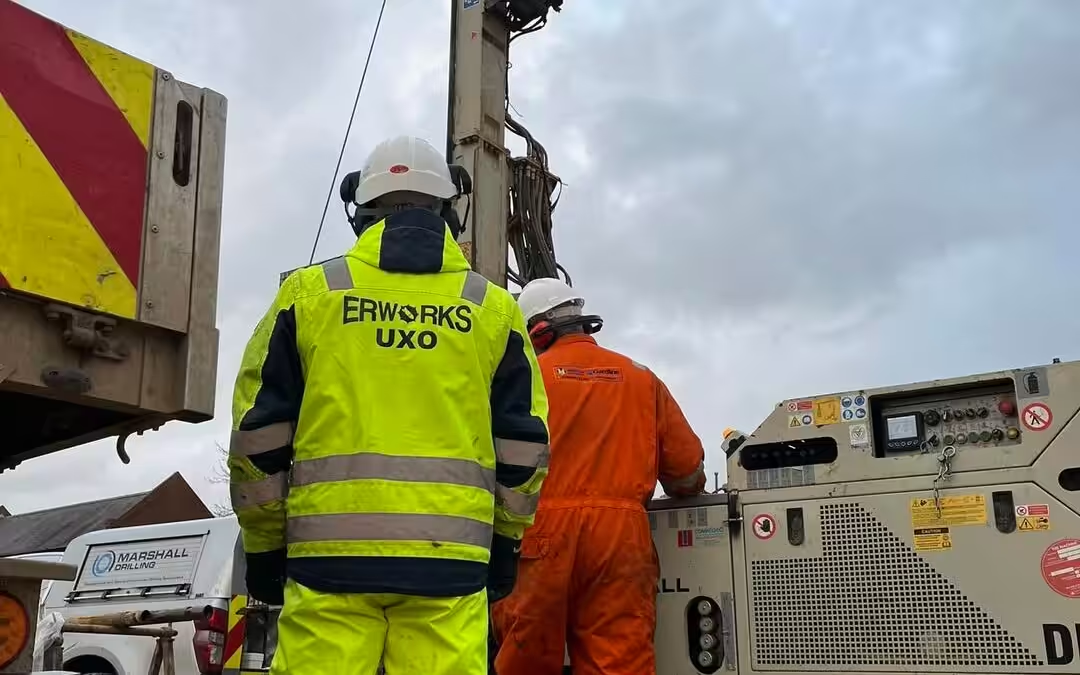
A recent ERWorks project, illustrated in the accompanying site image, shows an EOD Engineer overseeing borehole operations. This activity represents a core part of our work: ensuring the safety of personnel, plant and infrastructure during intrusive investigations. Borehole drilling is an essential technique for geotechnical assessment, but when UXO risk is present or cannot be ruled out, it becomes a high-value point of control for managing subsurface hazards.
This article outlines the role of an ERWorks EOD Engineer during borehole investigations, the procedures involved, and the benefits this provides to developers, contractors and consultants operating across the UK.
Understanding UXO Risk in Ground Investigations
The UK has extensive areas where UXO contamination remains possible due to historic bombing, munitions manufacturing, testing, training and storage. Even in locations where surface evidence no longer exists, subsurface hazards may persist for decades.
Before any borehole activity takes place, ERWorks typically undertakes a structured risk-assessment process, including:
- A Desk-Based Assessment of the site’s historical military activity
- Review of bombing records, mapping and archive sources
- Analysis of ground conditions in relation to potential ordnance burial or migration
- Determination of the likelihood and potential severity of encountering UXO during intrusive works
When this assessment identifies a potential hazard—or when uncertainty remains—supervised intrusive works become an essential mitigation tool. Boreholes, trial pits and CPTs allow teams to assess geology and load-bearing properties, but they also create the potential to encounter metallic anomalies or hazardous items. This is where EOD supervision provides critical risk control.
The Role of an ERWorks EOD Engineer
During borehole investigations, ERWorks deploys qualified and experienced EOD Engineers to supervise drilling and manage any UXO-related risks. Their responsibilities include monitoring, assessment, communication and the implementation of safety procedures designed to protect everyone on site.
Real-Time Monitoring
At set depths, the borehole is investigated by the engineer using the Sensys SBL10 & FMG400 weighted probe. The investigation confirms whether a magnetic anomaly is present or not, and it is safe to proceed with the borehole operations to the maximum bomb penetration depth and onwards to the maximum borehole sampling depth requirement.
The EOD Engineer observes drilling progress continuously, watching for:
- Sudden changes in drilling resistance
- Retrieval of suspicious materials
- Metallic fragments within arisings
- Irregularities in the borehole profile
- Any physical indicators that may suggest buried ordnance
By monitoring as the ground is broken, risks can be identified early, reducing the likelihood of accidental impact with hazardous items.
Immediate Identification and Assessment
If materials raise concern, the EOD Engineer is able to:
- Conduct an initial visual inspection
- Assess the characteristics of the item or anomaly
- Determine the nature of the risk
- Advise the site team on next steps
This rapid assessment is key to minimising delay and ensuring that safety decisions are accurate and justified.
Implementation of Safety Protocols
The EOD Engineer enforces safe working distances, stop-work triggers and controlled processes for handling potential UXO encounters. Should a risk be confirmed or strongly suspected, the Engineer can instruct the team to pause work and initiate further investigation or clearance measures.
Coordination with Site Teams
Clear, concise communication with drillers, geotechnical staff and site managers ensures that everyone understands the procedures in place. ERWorks places strong emphasis on maintaining safe progress without introducing unnecessary disruption to the project timeline.
Documentation and Reporting
Following supervised borehole works, ERWorks provides documented evidence of findings, assessment outcomes and any actions taken. This creates a clear audit trail and informs the next stages of development, whether that involves construction, deeper intrusive works or ground remediation.
Why Borehole Supervision Matters
Borehole drilling is often undertaken early in the design and planning process. Because it penetrates deeper soil layers, this phase has the potential to encounter items that would not be detected during shallow excavations or surface surveys. A single unexpected anomaly can impact safety, schedules and cost if not managed correctly.
Supervision by an EOD Engineer helps to:
- Reduce the likelihood of accidental detonation or impact with a hazardous item
- Ensure compliance with relevant guidance and industry standards
- Provide reassurance to duty-holders and contractors
- Maintain operational efficiency by enabling immediate, informed decision-making
- Support safe continuation of the wider investigation or build programme
For sites with any level of UXO uncertainty, supervised intrusive works are considered a best-practice measure that protects both personnel and project deliverability.
Integration with Wider ERWorks Services
EOD supervision during borehole investigations is one component of ERWorks’ broader UXO risk-management framework. Our services typically integrate:
- Desk-Based UXO Risk Assessments
- Detailed Risk Assessments with site-specific analysis
- Non-intrusive geophysical surveying
- Intrusive UXO surveys and Probing
- Borehole and CPT supervision
- Trial pit monitoring
- EOD identification and disposal support
- Ongoing advisory and documentation services
By managing risks from the earliest planning phases through to active groundworks, ERWorks provides a complete approach designed to enable safe and efficient development.
Supporting Safe and Confident Development
Every site carries unique characteristics shaped by its historical use and geological conditions. As development extends into areas with complex pasts, effective UXO risk mitigation becomes increasingly important. ERWorks’ involvement during borehole investigations forms a critical layer of safety control, ensuring that risks are identified early and managed appropriately.
The recent project image showing an ERWorks EOD Engineer on site is a clear reflection of what we do every day: support ground investigation teams, protect infrastructure, and enable development to proceed with confidence. Through technical expertise, structured methodology and a commitment to safety, ERWorks continues to assist clients across the UK in delivering projects safely and efficiently.
If your project requires intrusive works in an area with potential UXO risk, our team is available to provide guidance, assessment and on-site supervision tailored to your specific requirements.